
AI Assistant & Voice Commands
Quasar's AI Assistant lets you control the application by voice or by typing plain-English commands. You can open screens, fill fields, search lookups, navigate lists, press buttons, manage windows, and ask questions. All chat — typed or spoken — is answered by the Quasar server: how-to questions are answered from the help documentation shipped with Quasar, and if your security type permits it, the assistant can also answer from live company data (counts, lists, and reports). The assistant says when it is not sure instead of guessing. Skills and providers are configured in AI Skill Master and AI Provider Master.
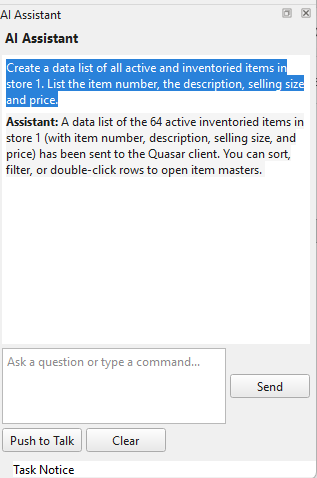
The AI Assistant panel answering a data-list request. The input box takes both questions and commands; Push to Talk speaks a request, Clear empties the box and starts a fresh conversation.
Two Modes
The AI Assistant panel always opens in text mode — via View › AI Assistant, the dock toggle, or voice menu navigation ("Click View", then "Toggle AI Assistant") — with the input focused, even when voice is available. Voice chat starts only when you say or type Quasar chat.
| Mode | What it does | How to start | How to exit |
|---|---|---|---|
| Voice/Chat Commands | Executes one command at a time. | Press F7 or click the microphone button. | Say/click close, press Escape, or say Quasar command. |
| Voice Chat | Spoken conversation with the AI. Your words are transcribed through the same speech-to-text stream used for voice commands and answered by the Quasar server; answers appear as text in the AI Assistant panel (spoken replies are an optional per-workstation setting — see below). Answers come from the shipped help documentation and, subject to your security permissions, from live company data; the assistant can also open screens, open help pages, and focus fields on request (subject to your security permissions and the skill's allowed actions). The text input stays usable: with hands-free mode on, speech is transcribed continuously and builds up one request in the input line — pause mid-thought and keep talking, then say click send (or click Send) to submit it, or clear to discard it and start over. With hands-free off (economy, the default), no stream is open: hold Push to Talk to speak, release to send. | Say or type Quasar chat. If no voice-capable skill is configured, Quasar chat opens the panel in text mode instead. | Say Quasar command or close as a complete utterance ("Close." is tolerated): the panel closes and command-mode transcription resumes. |
Speech-to-text runs on the workstation; everything else runs on the server. Voice commands and voice chat share the provider's Voice Command URL (streaming speech-to-text, derived from the Text Chat URL when left blank), and if the transcription connection drops during voice chat Quasar reconnects automatically. Chat questions — typed or spoken — are sent as text to the Quasar server, which resolves which skill and provider answers, enforces your security permissions, and can query the company database for live answers. There is no per-workstation AI bridge or Python setup. Closing or floating the AI Assistant panel restores the main Quasar window to its original size, like the Field Help panel.
The panel has three buttons: Send submits the input line, Push to Talk opens the speech-to-text stream while held (billing only for as long as you hold it), and Clear empties the input line and starts a fresh conversation. Turning the microphone on while the panel is visible puts you in voice chat rather than command mode, so what you say goes to the assistant as a question.
Asking Questions
In voice chat or typed chat, ask the assistant how Quasar works — what a field means, what a screen does, or how to complete a task — or ask about your own company data, such as "count active customers" or "list customer accounts for Mary Ball*". How-to questions are answered from the help pages and user-guide chapters that ship with Quasar; data questions are answered live from the company database by the server, subject to your security permissions. The assistant tells you when it is not sure rather than inventing an answer.
- "How do I …" questions (dayend, selling a gift card, price batches) fetch the relevant user-guide chapter, and the assistant walks you through it step by step, one step at a time.
- Live data questions — counts, lists, and AI reports are answered from your company database. They require the AI Data Assistant flag on your security type. The assistant can also draft job proposals (AI Action Assistant flag); proposals are drafts only and nothing is executed without human review. Users without these flags get documentation help only.
- Reports open in the Report Viewer — when an answer is a table or a longer list (sales by department, vendor balances, invoice listings), the assistant opens it in the Quasar Report Viewer instead of dumping it into chat, so you can print, PDF, or export it. Totals and subtotals in the viewer are computed by Quasar; chat keeps a one-line headline of the result.
- Acting on request — in chat the assistant can open screens, open help pages, and focus fields when you ask, respecting your Quasar security permissions and the skill's allowed actions.
- Typed input — text starting with a command keyword (such as
open,set, orgoto) runs as a command, shown with aCommand:prefix; anything else is answered by the AI.
Reports and Data Lists
Data answers come back in two forms, chosen from how you ask:
- Interactive data lists — ask to list something: "list all customers and their current balances, sorted by balance", or "list the transactions created by Mary Ballantyne on January 23, 2026, with the time, type, and total". The answer opens as an interactive list window: click a column header to sort, and double-click a row to open that record (customer, transaction, item) in its own screen. Money and percent columns follow the usual Quasar formatting, and a totals footer sums the money columns.
- Reports in the Report Viewer — ask for a report, or for anything with totals or subtotals: "create an AR report for 2025 subtotalled by customer by month, with beginning balance, debits, credits, and month-end balance". The report opens in the Quasar Report Viewer, grouped and subtotalled the way you asked, ready to print, PDF, or export.
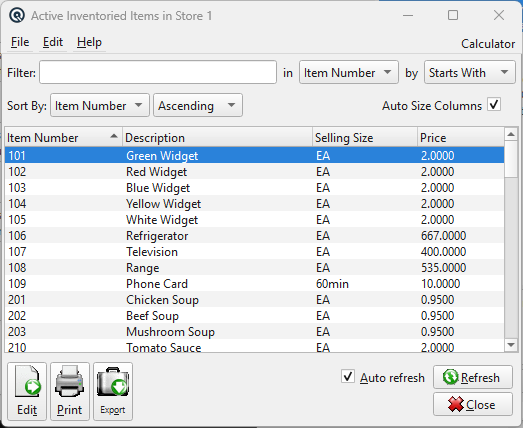
A data list produced by the assistant. The title is its own description of what you asked for. Filter, sort, column configuration, print and export all work as on any Quasar list, and double-clicking a row opens that record; New and Delete are hidden because the list is read-only.
Rule of thumb: anything needing totals or subtotals becomes a report; anything you would want to browse and drill into becomes a list. You can steer the choice with your wording — "list … to drill down" versus "create a report …". Both respect your security permissions: you only ever see data your security type allows you to view.
Follow-ups: refine in plain language — "same report but only customer 527", "sort by balance descending" — and the assistant adjusts the query instead of starting over. Reports and lists reflect the database at the moment you ask; ask again for fresh numbers.
Edit request: an AI-generated report opens with an Edit request button beside Regenerate. It reopens the AI Assistant panel with the original question already in the input line, so you can fix a wrong month, add a column, or change the grouping and resubmit without retyping. You can dictate the change instead of typing it — an addendum that does not repeat the original wording is sent together with the original request so the assistant keeps the full context. Only reports the assistant produced have this button.
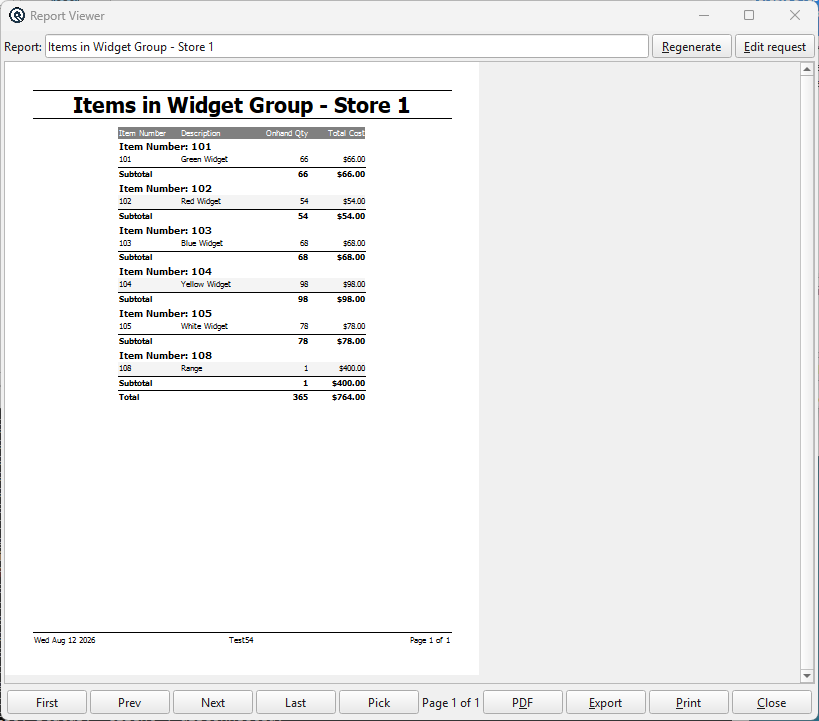
An assistant-generated report. Edit request sits beside Regenerate and hands the original question back to the AI Assistant panel for editing. The title, columns, subtotals and grand total all follow from how the question was worded, and Print, PDF and Export behave as on any Quasar report.
Column formatting: the assistant declares which columns hold money and which hold percentages, and Quasar renders them with standard formatting. If a declaration is missing, Quasar infers it from the column name or label — but quantity and count columns are never formatted as money, so "total quantity sold" and "sales count" stay plain numbers despite containing "total" and "sales".
Activation and Muting
| Say or type | Result |
|---|---|
F7 | Toggle listening on/off. Right-click the mic button in the navigation sidebar and choose Voice/Chat Settings... for the settings dialog (hands-free mode, spoken replies). |
start listening | Begin capturing voice commands. |
stop listening | Stop capturing voice but keep the assistant enabled. |
mute / Quasar sleep | Stop acting on commands. Economy mode (default): the voice stream closes and speech-to-text billing stops — resume with F7 or the mic button. Hands-free mode: the microphone keeps streaming so Quasar wake is still heard. |
unmute / Quasar wake | Resume acting on commands (reopens the voice stream in economy mode; the wake word works only in hands-free mode, since the economy stream is closed while muted). |
Quasar chat | Start continuous voice chat (panel shows Voice Chat Active and answers appear as text in the panel); falls back to text mode if no voice-capable skill is configured. |
Quasar command / Quasar commands | End voice chat: close the panel and resume command-mode transcription. With the panel in text mode, simply closes it. |
click send (voice chat) | Send the request accumulated in the input line. press send does the same. |
clear (voice chat) | Empty the input line and start a fresh conversation, discarding both the request being dictated and the earlier exchange. click clear and press clear do the same. |
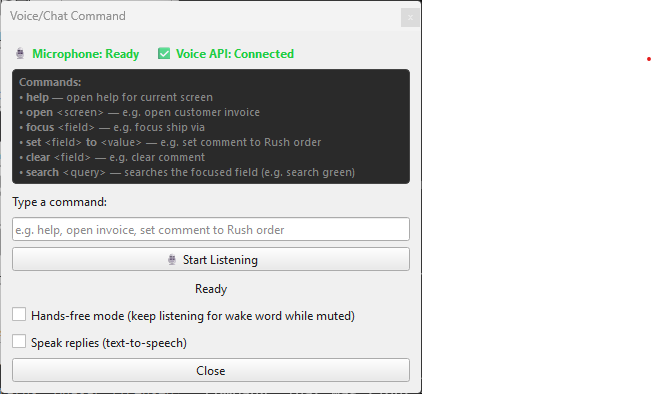
The Voice/Chat Command dialog — right-click the microphone button in the navigation sidebar and choose Voice/Chat Settings... The status lines show whether the microphone and the provider's speech service are reachable; Type a command runs commands without the microphone; the two checkboxes are stored per workstation.
Economy vs. hands-free. Open the Voice/Chat Command dialog — right-click the mic button in the navigation sidebar and choose Voice/Chat Settings... — and use the Hands-free mode checkbox (stored per workstation, off by default). Leave it off (economy) to stop speech-to-text charges whenever you mute or go quiet for 5 minutes — the stream closes and you resume with F7 or the mic button. Check it if you cannot reach the keyboard: the microphone keeps streaming while muted so Quasar wake is always heard, and there is no idle auto-pause (speech-to-text charges continue while muted). The same dialog has a Speak replies checkbox (off by default, per workstation): when checked, the assistant's final answer to each chat question is also spoken aloud through the speakers, and the microphone ignores everything while a reply is playing so the speakers cannot trigger a new question.
Navigation and Screens
| Command | Example | Result |
|---|---|---|
help | help | Open help for the current screen. |
help <topic> | help price batches | Open the help page matching the topic. |
open <screen> | open customer invoice | Open the requested screen. Names are matched loosely and common aliases are built in — open customer invoice opens Invoice Master, open vendor invoice opens Vendor Invoice / Receive. |
nav <node> | nav sales | Find and highlight a navigation node. |
nav search <query> | nav search customer | Filter the navigation tree. |
focus <window> | focus customer invoice | Switch to an open tab or window. |
goto <field> | goto customer | Move focus to a field. |
goto tabbar <tab> | goto tabbar tenders | Switch tabs within the current screen. |
goto table | goto table items | Focus the first or named table. |
goto list | goto list | Focus the first list view. |
tab / next | tab | Next field. |
back tab / previous | back tab | Previous field. |
enter / return | enter | Press Enter or activate selected item. |
select | select | Choose the highlighted list item. |
select <query> | select customer 123 | Search a lookup and pick the first result. |
Data Entry
| Command | Example | Result |
|---|---|---|
set <field> to <value> | set comment to rush order | Fill a named field. |
fill <field> <value> | fill customer Acme | Alternate form of set. |
type <value> | type 123 Main Street | Enter value into focused field. |
text <value> | text approved | Alias for type. |
clear | clear | Clear focused field. |
clear <field> | clear comment | Clear named field. |
check / uncheck / toggle | check | Act on the focused checkbox. |
check <field> | check active | Check a named checkbox or column. |
filter <text> | filter green | Set the first filter field and refresh a list. |
search | search | Search focused lookup using its current text. |
search <query> | search Acme | Search focused lookup for the query. |
Lists, Tables, and Navigation Keys
| Command | Result |
|---|---|
up / down | Move up or down one row/item. |
left / right | Move left or right; collapse/expand tree nodes. |
back / expand / collapse | Collapse or expand tree nodes. |
page up / page down | Scroll one page. |
enter table | Move into the first or named Quasar table. |
move up/down/left/right | Move the active MDI window 50 pixels. |
Buttons, Keys, and Dialogs
| Command | Result |
|---|---|
ok / okay / cancel / yes / no / save / close | Click the corresponding dialog button. |
button <name>, press <name>, click <name> | Click a button, toolbar button, or menu action. |
spacebar / space | Press Space. |
backspace / delete / escape | Press the corresponding key. |
refresh | Refresh the current list screen. |
Window Management
| Command | Example | Result |
|---|---|---|
maximize / minimize / restore | maximize | Change window state. |
restore <name> | restore customer invoice | Restore a specific window/tab. |
full screen | full screen | Toggle full-screen. |
snap <direction> | snap left, snap top right | Snap window to half or quarter screen. |
wider <N> / narrower <N> | wider 50 | Resize width. |
taller <N> / shorter <N> | taller 30 | Resize height. |
width +/- <N> | width plus fifty | Resize width. |
height +/- <N> | height minus twenty | Resize height. |
horizontal / vertical +/- <N> | horizontal plus twenty | Synonyms for width / height, for when speech-to-text mishears them. |
move left/right/up/down <N> | move left 100 | Move window. |
Spelling and Numbers
| Command | Example | Result |
|---|---|---|
spell <letters> | spell A C M E | Type "acme". |
spell upper <letters> | spell upper G S T | Type uppercase. |
spell lower <letters> | spell lower abc | Type lowercase. |
written <number> | written 101 | Type "one hundred and one". |
digit <number> | digit twenty five | Type digits. |
number <number> | number one hundred | Same as digit. |
AI-Parsed Actions
Typed or spoken commands that are not built-in commands may be sent to the server AI, which returns one of these structured actions for the workstation to execute. Allowed actions are configured per skill.
| Action | Example command | Result |
|---|---|---|
open_screen | open customer invoice | Open the requested screen. |
focus | focus customer | Move focus to a field. |
fill | set customer to Acme | Fill a field. |
fill_range | set date range from 2024-06-01 to 2024-12-31 | Fill a date range. |
clear | clear customer | Clear a field. |
search | search Acme | Open a lookup search. |
help | help | Open help or answer a question. |
Report Viewer Commands
When a report is the active window — whether the assistant produced it or you ran it yourself — these commands drive the Report Viewer. It is not a data-entry screen, so it has its own command set, and these take priority over general commands of the same name while it has focus.
| Say or type | Result |
|---|---|
next / next page / page down / down page | Next page. |
previous / prev / page up / up page | Previous page. |
first / first page | First page. |
last / last page | Last page. |
print | Print the report. |
pdf / export pdf | Export as PDF. |
export | Open the export dialog (CSV and other formats). |
zoom in / zoom out | Change the zoom level. |
close | Close the Report Viewer. |
The viewer also takes keyboard input directly: Home and End for first and last page, Page Up / Page Down and the arrow keys to move through pages and lines, + / - to zoom, and A to auto-scale to the window.
Calculator Commands
When the Calculator is open, speak numbers and operators: plus, minus, times, divide, equals, percent, dot, clear.
Tips for Best Results
- Exact wording is not required; Quasar matches names loosely.
- Security permissions still apply.
- Use
spellfor codes and abbreviations. - Use
digitornumberto force numeric entry. - Quasar auto-corrects speech-to-text misspellings of "Quasar".
- American "check" is normalized to Canadian/British "cheque".
muteignores commands until you unmute. In hands-free mode the microphone stays live soQuasar wakeis heard; in economy mode (the default) the stream closes and you resume withF7or the mic button.- The assistant answers questions from the shipped help pages and user guide — and, with the AI Data Assistant flag on your security type, from live company data — and says when it is not sure instead of guessing.
- "How do I …" questions are answered step by step from the matching guide chapter.
- Voice chat answers appear as text in the AI Assistant panel; optional spoken replies can be enabled with Speak replies in Voice/Chat Settings (right-click the mic button). If the transcription connection drops, voice chat reconnects automatically.
- In chat the assistant can open screens, open help pages, and focus fields on request; typed text starting with a command keyword still runs immediately as a command.
- Dictate long requests in pieces — in hands-free voice chat the input line keeps everything you say until you send it. Say
click sendwhen finished, orclearto start over. - Use Edit request in the Report Viewer to correct an AI report without retyping the question that produced it.
Setup
- AI Skill Master — create skills and choose allowed actions. For voice, set one Voice Command skill as the workstation's active voice skill (Set Active); the choice is stored per workstation, so set it once on each workstation that uses voice.
- AI Provider Master — configure provider, API key, and endpoint URLs.
- AI Skill List — manage skills.
Chat is answered by the server, not the workstation: the Quasar server resolves which skill and provider answers each chat request. The server-side AI services start automatically with quasard; administrators configure /etc/quasar-http.conf (a template ships as quasar-http.conf.example). No Python or AI bridge setup is needed on workstations.