
Purchases
Vendor Claim
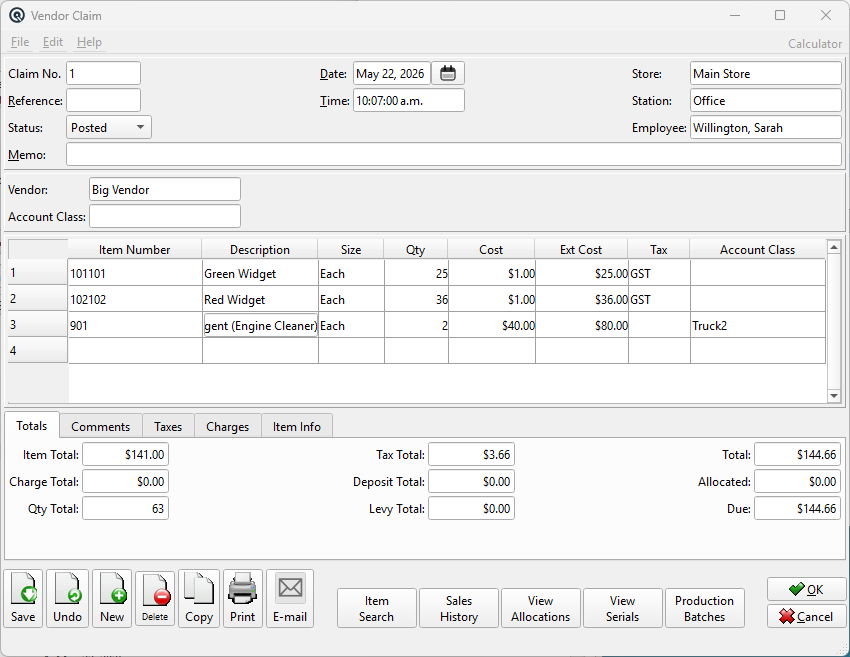
The Vendor Claim screen creates debit memos and vendor returns for damaged, defective, or incorrect items. It reduces the vendor's accounts payable balance and can be allocated against outstanding vendor invoices. Supports serial number tracking, batch/expiry management, internal and external charges, and production batch lookups. Access from Purchases › Vendor Claims, or via the Make Claim button on the Vendor Invoice screen.
Header Fields
Claim No.System-generated claim number. Uses the standard Gltx frame with Store, Date, Time, Station, and Employee fields. Sequence numbering is by store. VendorThe vendor being claimed against (lookup). Changing the vendor clears existing items (with confirmation) and recalculates costs for the new vendor's pricing. Account ClassOptional account class for the whole claim. Used when the Account Classes feature is enabled and the claim is for purchase-only items that post to expense accounts. Only visible when the feature is enabled. NumberTransaction number. Auto-generated by default; enter # for next sequence number. ReferenceReference string for cross-referencing or notes (optional). StatusTransaction status. Controls posting and visibility in lists. DatePosting date for the transaction. Defaults to today. TimeTime of posting. Auto-filled from the system clock. Work DateWork date for the transaction (may differ from posting date). ShiftShift assignment for labour or shift-based reporting. StoreStore where the transaction is posted. Defaults to current store. StationWorkstation or terminal where the transaction was entered. EmployeeEmployee who created or is responsible for the transaction. MemoFree-form memo or notes attached to the transaction. |
Item Lines
|
Items being returned or claimed. Lookup is restricted to purchasable items. Items must be stocked in the selected store, not discontinued, and have a cost record for the vendor.
|
Totals Tab

|
Read-only summary of the claim value. Item TotalSum of all item extended costs. Charge TotalSum of internal and external charges. Qty TotalTotal quantity of all claimed items. Tax TotalTotal tax on exclusive items. Deposit TotalTotal container deposits. Levy TotalTotal environmental or other levies. TotalGrand total of the claim (credit amount). AllocatedAmount already allocated against vendor invoices. DueUnallocated balance (Total − Allocated). This is the credit still available to apply to invoices. |
Comments Tab

CommentFree-text comment field. Document the reason for the claim (e.g. "Damaged in shipping", "Wrong items received", "Short shipment on PO #1234"). |
Taxes Tab

Tax BreakdownRead-only tax breakdown grouped by tax code. Columns: Tax, Name, Taxable, Tax Amt, Inc. Taxable, Inc. Tax Amt. |
Charges Tab

|
Two side-by-side tables for charges associated with the claim: Internal Charges (left)Costs absorbed internally (e.g. restocking fees, return shipping). Each charge has a Charge lookup, Amount, and Tax code. These are allocated across item lines. External Charges (right)Charges passed to the vendor (e.g. vendor-credited shipping). Each charge has a Charge lookup and Amount. |
Item Info Tab

|
Detail panel for the currently selected item line. Updates as you navigate between rows. Include Tax?When checked, the line cost is treated as tax-inclusive. Include Deposit?When checked, the line cost includes deposit amounts. DepositContainer deposit amount for this line. LevyEnvironmental or other levy amount. Batch NumberManufacturer's batch/lot number being returned. Expiry DateExpiration date of the items being returned. Line CostExtended base cost (before deposits/levies/charges). Read-only. Internal ChargeAllocated internal charge for this line. Read-only. External ChargeAllocated external charge for this line. Read-only. Edit SerialsButton. Opens the serial number assignment dialog for serial-tracked items being returned. |
Action Buttons
Item SearchOpens a search dialog to find items within the claim by Item Number or Description. Navigates to the matching row. Sales HistoryOpens the Sales History window pre-loaded with the currently selected item and store. Stays open and updates as you navigate between items. Useful for checking recent sales volumes when evaluating damaged stock claims. View AllocationsOpens the Claim Allocation dialog showing how this claim has been applied against vendor invoices. Prompts to save first. After closing the dialog, the screen refreshes to reflect any allocation changes. The Allocated and Due amounts in the Totals tab update accordingly. View SerialsOpens a dialog showing all serial numbers assigned across all claim lines. Serial assignments can be reviewed and modified. Items without serial tracking are excluded. Production BatchesOpens the Production Batch window pre-loaded with the currently selected item and store. Useful for investigating production-related defect claims. |
Standard Buttons
SaveSaves the claim, creating the AP credit entry. Optionally prompts to print. Prints the claim using the Emails the claim document to the vendor. CopyDuplicates the claim with a new number, today's date, and cleared serial numbers. CancelCloses the screen. |
Menu: Recurring
|
Available from the File menu. Opens the Recurring transaction dialog to set up this claim as a recurring entry. |
Related Screens
| Claim List | Vendor Invoice | Vendor Master |
| Quasar Accounting 7.1 • © Linux Canada Inc. • Table of Contents |